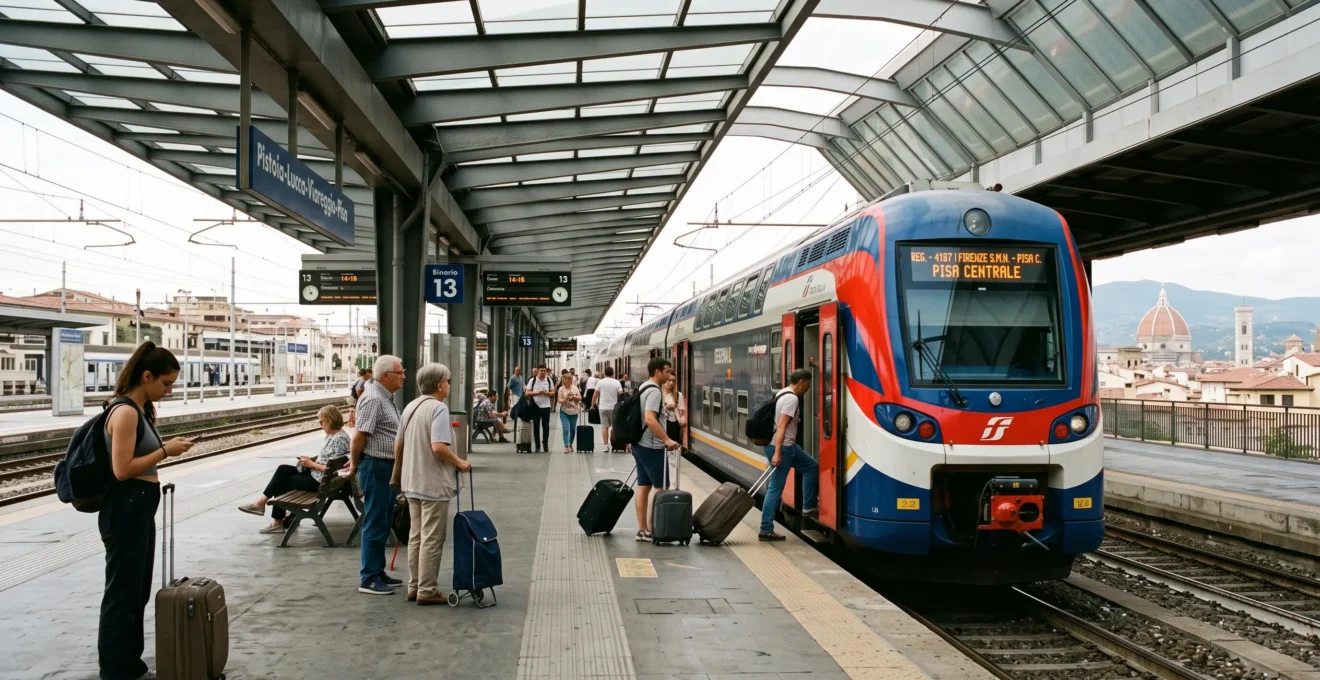
Yes, you can visit Tuscany without renting a car — if your trip is built around its cities. Florence, Pisa, Siena and Lucca are all linked by a regional rail network, and each is perfectly walkable. What a car-free trip struggles with is rural Tuscany: the Val d’Orcia, the deeper Chianti hills and the hilltop villages, where public transport is sparse and weekend service shrinks further. Before booking anything, decide which Tuscany you’re actually going for — then match your transport method to it. This guide gives you the decision framework, an option-by-option comparison, a planning method for a car-free day or week, and a warning about the one booking mistake that can derail the whole trip.
Visiting Tuscany Without a Car: What’s Actually Possible
Visiting Tuscany without a car is a two-level decision. Level one: the major cities — Florence, Pisa, Siena and Lucca — are fully reachable by regional train, so a city-based itinerary is genuinely practical for most travelers. Level two: exploring the countryside (Val d’Orcia, Chianti, hilltop villages) depends on structured solutions such as organized excursions or hop-on hop-off tours, because public transport thins out quickly outside the urban network. Diagnosing which level your trip belongs to is the first step, and it changes everything about how you book.
The « cities » case rests on a functioning regional rail backbone. Trenitalia‘s regional Tuscany Line connects the region’s main art cities and villages, with published per-segment fares for routes such as Pisa–Lucca and Pistoia–Florence — a network built around city-to-city links, not rural coverage. Fares and schedules are indicative and change with the season, so check current timetables before travel.
The « countryside » case rests on documented limits in specific rural zones. In the Chianti countryside, travelers researching bus schedules in the Chianti countryside are warned to check timetables carefully, especially on Sundays and holidays when buses run even less often, with no direct connections between many main destinations. Beyond these named areas, the broader pattern — rural Tuscany as a whole being thinly served, with weekend service shrinking further — is this guide’s synthesis rather than a sourced finding. The practical takeaway: a car-free countryside trip is possible, but only by plugging into a structured solution. Bus tour operators such as Tootbus, for example, run structured sightseeing experiences in Tuscany from €34.30, with walking tours and multilingual audio guides included — one real example of how the countryside gap gets bridged, covered in detail below.
The decision rule, in one extractible grid:
| Type of Tuscany | Feasibility without a car | Solution required |
|---|---|---|
| Major cities (Florence, Pisa, Siena, Lucca) | High — entirely feasible | Regional trains between bases; walking within cities |
| Rural areas (Val d’Orcia, Chianti, hilltop villages) | Conditional — feasible only with structure | Organized excursions or hop-on hop-off tours; a rental car for a single day as a fallback |
Train vs Bus vs Organized Tours: Choosing the Right Option for Your Trip
Choosing between trains, regional buses and organized tours comes down to three criteria: budget, schedule flexibility and depth of coverage. Trains win on budget and speed between cities; regional buses extend reach at the cost of rural reliability; organized tours buy coverage of areas trains and buses don’t serve well. The comparison below shows when each option becomes the right pick for a specific Tuscan trip.
| Criterion | Regional trains | Regional buses | Organized tours (hop-on hop-off) |
|---|---|---|---|
| Budget | Low: Florence–Pisa roughly 11–19andFlorence–Sienaroughly11–19 and Florence–Siena roughly11–19andFlorence–Sienaroughly13–22, per aggregated route data (indicative) | Low fares, but often multiple connections | From €34.30 for Tootbus’s entry Tuscany experience; higher than a single train ticket, but bundled |
| Schedule flexibility | High on main lines: Florence–Pisa runs at least twice per hour (fastest ~51 min); Florence–Siena roughly hourly | Low in rural areas: infrequent service, sharply reduced on Sundays and holidays | Fixed routes and times, but hop-on hop-off passes over 1, 2 or 3 days let you structure each day |
| Coverage depth | Strong city-to-city; weak for villages off the rail lines | Extends beyond rail in theory; in practice sparse around Val d’Orcia towns, where a travel guide notes infrequent bus service around Val d’Orcia towns and few options once you arrive without a car | Highest for car-free travelers: reaches areas public transport doesn’t, often with guided components |
For the organized-tour column, one concrete, verifiable offer illustrates the category. Tootbus — a bus sightseeing operator — sells 4 experiences in Tuscany starting at €34.30, built on hop-on hop-off formulas valid for 1, 2 or 3 days. Each includes free walking tours, a multilingual audio guide, onboard Wi-Fi and a real-time bus tracking app, with combo tickets pairing the bus with local attractions. That’s the offer as Tootbus describes it; it is an example of one operator’s format, not a market-wide standard, but it shows what the « organized tour » option now typically bundles for car-free travelers: transport, on-foot exploration and commentary in one ticket.
When does each option become the right choice? Train if your itinerary stays within Florence, Pisa, Siena, Lucca and similar rail-served towns on a tight budget. Regional bus if a specific destination is bus-only and you can build your day around a checked timetable. Organized tour if rural landscapes or villages are the point of your trip and you want coverage without driving — check current current Florence–Pisa and Florence–Siena train frequencies and fares first to see how far the rail backbone alone gets you.
How to Plan a Car-Free Day (or Week) in Tuscany
Planning a car-free stay in Tuscany works as a four-step method: pick a well-connected urban base, attach a structured transport solution, pair it with walking tours and an audio guide, and use tracking tools to remove schedule uncertainty. Applied in order, these steps turn the no-car constraint into a marked-out itinerary rather than a limitation. The same base-transport-walk logic scales to other destinations too, as this guide to the best ways to get around when traveling shows for Ireland.
- Choose a well-connected urban base. Florence is the natural hub — central, rail-linked to Pisa, Siena and Lucca, and walkable end to end. Siena or Lucca work as quieter alternatives for a slower-paced week.
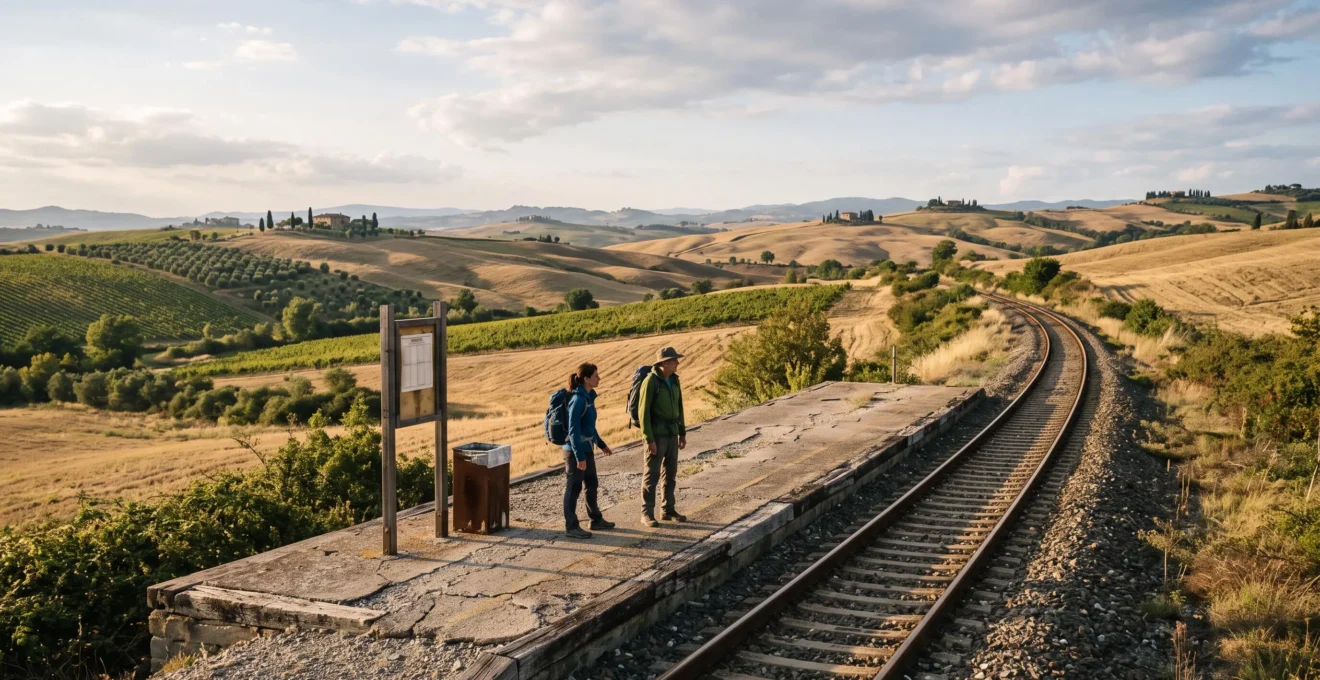
- Select the structured transport that matches your day. Regional trains for city-to-city legs; organized excursions for destinations off the rail network. Travel guides covering Florence day trips are blunt on this point: medium and large towns are easily reached by train, while small villages are often off the railway lines, and organized tours become the way to reach villages off the rail network without driving.
- Combine walking tours with an audio guide. Tuscan cities are compact; a guided walk orients you on day one, and a multilingual audio guide fills the context at your own pace afterward.
- Integrate tracking tools. Real-time bus or tour tracking removes the main stress of fixed-schedule transport: not knowing when the next departure arrives.
One operator’s offer shows the full method assembled in a single product. For travelers who want that structure without piecing it together themselves, Tootbus packages the model directly: its hop-on hop-off buses carry you between stops, free walking tours are included in the price, a multilingual audio guide covers the commentary, and its mobile app shows bus locations in real time — with Tuscany experiences starting from €34.30 (full details in the comparison above). It’s the offer of this specific brand rather than an industry norm, but as a case it demonstrates how the constraint gets flipped: the bus carries you, the walking tours cover the pedestrian core, and the app handles the waiting.
Where a Car-Free Trip Breaks Down: Rural Tuscany Warning
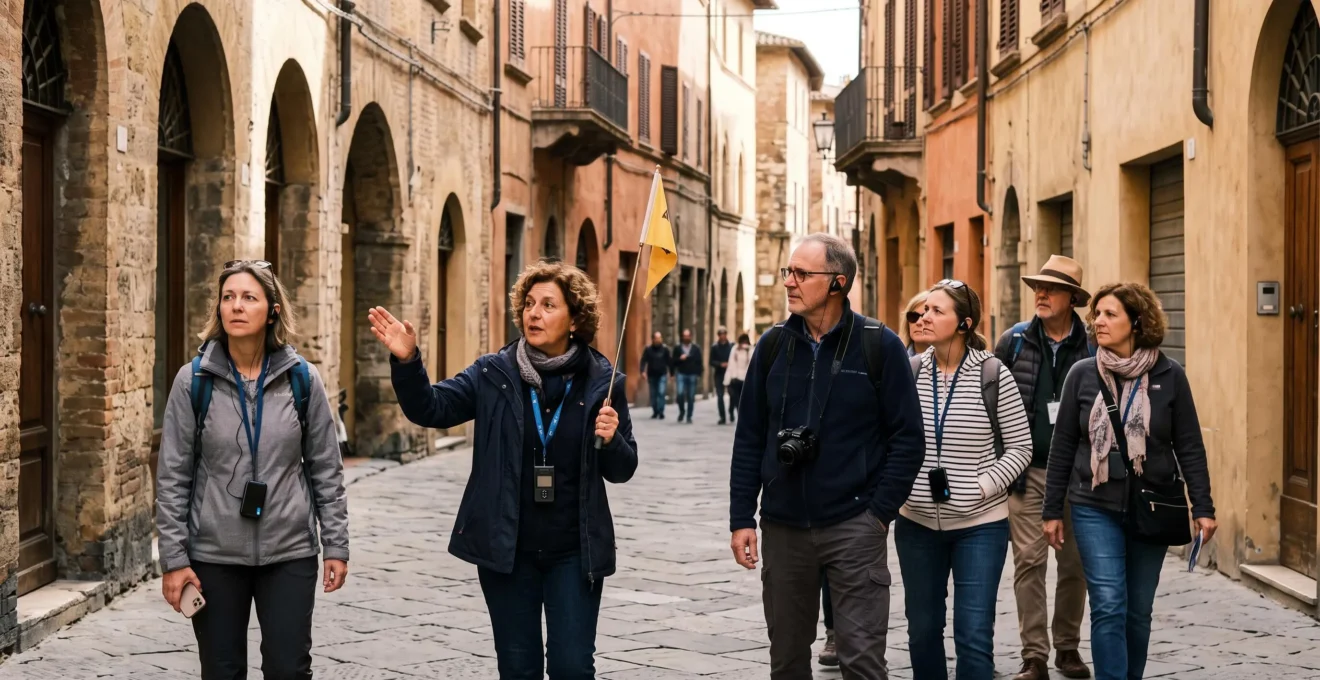
A car-free Tuscan trip breaks down in its rural zones: the Val d’Orcia, the Chianti countryside, the Crete Senesi and the agriturismo farm stays scattered between them are poorly served by public transport, with infrequent service and sharply reduced weekend schedules. The most expensive mistake is booking the postcard farmhouse before checking how you’d reach it — an inaccessible rural accommodation can force a costly late relocation. Experienced travelers on a Tuscany public transport forum advise planning a car specifically for the Chianti area, the Crete Senesi and the Val d’Orcia, while confirming that larger towns like Florence, Lucca and Siena remain strong transport hubs.
Three exits exist if rural Tuscany is non-negotiable for your trip — each fits a different situation:
- Organized excursion: the best fit if you want a single rural day without driving responsibility; departure is from a major city and someone else handles the route.
- One-day vehicle rental: worth it if you’re staying in a rural property for several nights or want full control of timing; book from a city agency and return it the same stay.
- Replan toward an urban base: the right call if your accommodation choice isn’t fixed yet — swapping a remote farmhouse for a base in Siena or Florence keeps the whole trip car-free and removes the access problem entirely.
The pattern to remember: check the accommodation’s access before booking it, not after. If a property lists « car recommended » in its description, treat that as a hard requirement for your current plan.
Quick Decision Guide: Is Your Tuscany Trip Feasible Without a Car?
Three questions settle whether your specific Tuscany project works without a car. Answer them in order and follow the pointer:
- Are you visiting cities or countryside? Cities (Florence, Pisa, Siena, Lucca): feasible by train — see the decision grid in the first section. Countryside (Val d’Orcia, Chianti, hilltop villages): feasible only with an organized excursion, a hop-on hop-off tour or a one-day rental.
- Tight budget or coverage priority? Tight budget: trains — roughly 11–19Florence–Pisaand11–19 Florence–Pisa and11–19Florence–Pisaand13–22 Florence–Siena per aggregated route data — plus walking tours. Coverage priority: an organized tour bundle, which packages transport, walking tours and audio guide in one price.
- Short stay or long stay? Short stay: base yourself in one city and use structured day solutions. Long stay: mix a city base with checked bus timetables, and revisit the rural warning before booking any countryside accommodation.
Run these three answers against the comparison table and the rural warning above, and your trip either confirms as car-free or reveals the one leg that needs a different solution. And if trains form your backbone, it’s worth reading up on booking train tickets in advance in Europe before locking your dates.