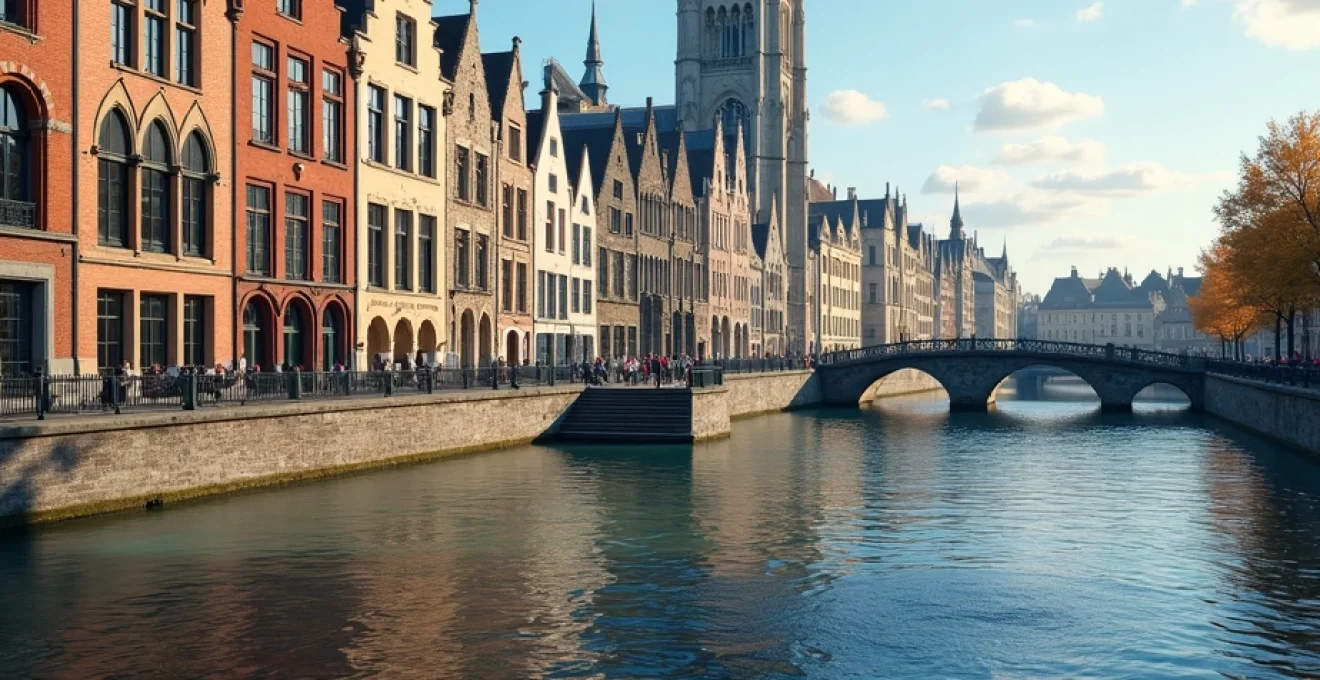
Nestled in the heart of Belgium’s Flanders region, Ghent stands as one of Europe’s most captivating yet underappreciated cultural destinations. This medieval gem, positioned strategically at the confluence of two major rivers, offers visitors an extraordinary blend of Gothic architecture, vibrant student life, and innovative gastronomy. Unlike its more touristy neighbour Bruges, Ghent maintains an authentic atmosphere where daily life seamlessly interweaves with centuries of history, creating an urban experience that feels both timeless and refreshingly contemporary.
The city’s remarkable preservation of medieval architecture, combined with its status as a thriving university town, creates a unique dynamic that sets it apart from other European destinations. From the world-renowned Van Eyck masterpiece housed in Saint Bavo’s Cathedral to the cutting-edge street art adorning Werregarenstraatje, Ghent presents a cultural tapestry that spans over a millennium. This exceptional diversity, coupled with its excellent transport connections and sustainable tourism initiatives, makes Ghent an increasingly compelling choice for discerning travellers seeking authentic European experiences.
Ghent’s strategic location within belgium’s east flanders province
Ghent occupies a pivotal position within Belgium’s East Flanders Province, serving as both the provincial capital and the country’s fourth-largest urban centre. The city’s location places it at the geographical heart of the historic Low Countries, making it an ideal base for exploring the broader Flemish region. This strategic positioning has shaped Ghent’s development over centuries, from its medieval prominence as a textile powerhouse to its contemporary role as a dynamic cultural and educational hub.
Geographic coordinates and distance from brussels international airport
Positioned at coordinates 51.0500° N, 3.7303° E, Ghent sits approximately 55 kilometres northwest of Brussels, Belgium’s capital and primary international gateway. The journey from Brussels Airport to Ghent typically takes just under an hour by direct train, with services running regularly throughout the day. This proximity to Belgium’s main aviation hub makes Ghent exceptionally accessible for international visitors, particularly those arriving from the United Kingdom, where direct flights to Brussels operate from multiple regional airports.
The efficient rail connection between Brussels Airport and Ghent eliminates the need for complex transfers or lengthy road journeys. Travellers can board trains directly from the airport terminal, reaching Ghent’s central station with minimal hassle. This seamless connectivity has contributed significantly to Ghent’s growing popularity as a weekend destination, particularly among visitors seeking an alternative to more crowded Belgian cities.
Proximity to major european capitals via High-Speed rail networks
Ghent’s integration into Europe’s high-speed rail network positions it within easy reach of major capitals and cultural centres. The city connects directly to the Thalys and Eurostar networks via Brussels, placing London just three hours away and Paris approximately three and a half hours distant. Amsterdam, another popular European destination, lies within two hours by high-speed rail, while Cologne in Germany can be reached in under four hours.
These excellent rail connections have transformed Ghent into an attractive component of multi-city European itineraries. Sustainable-minded travellers particularly appreciate the ability to explore multiple destinations without relying on air travel between cities. The efficiency of these connections also makes Ghent viable for business travellers, with morning meetings in Brussels and afternoon appointments in Amsterdam becoming entirely feasible within a single day’s journey.
Position along the scheldt and leie river confluence
The confluence of the Scheldt and Leie rivers has fundamentally shaped Ghent’s character and development throughout history. This strategic waterway intersection provided the foundation for the city’s medieval prosperity, enabling extensive trade networks that extended across Northern Europe. Today, these rivers continue to define Ghent’s urban landscape, creating the network of canals and waterways that give the city its distinctive charm and photogenic appeal.
The river system serves multiple contemporary functions beyond its historical significance. Recreational boating and canal tours have become integral to Ghent’s tourism offering, providing visitors with unique perspectives on the city’s architecture and urban planning. The waterways also support the city’s commitment to sustainable transportation, with water taxis and boat services reducing reliance on road-based transport within the historic centre.
Accessibility through port of ghent maritime gateway
The Port of Ghent represents one of Europe’s most significant inland ports, handling over 29 million tonnes of cargo annually. This maritime gateway connects Ghent to global shipping networks via the Ghent-Terneuzen Canal, which provides access to the North Sea. The port’s presence reinforces Ghent’s role as a major logistics and industrial centre, supporting diverse industries from steel production to automotive manufacturing.
For visitors, the port’s industrial heritage adds another layer to Ghent’s complex identity. Former industrial sites have been transformed into cultural venues and recreational spaces, demonstrating the city’s ability to adapt historical infrastructure for contemporary purposes. This industrial-to-cultural transformation exemplifies the broader European trend of urban regeneration, making Ghent a fascinating case study in sustainable city development.
Medieval architecture and UNESCO world heritage significance
Ghent’s architectural heritage represents one of the finest examples of medieval urban planning in Northern Europe. The city centre contains more protected historical buildings than any other location in Belgium, creating an extraordinary outdoor museum that spans nearly eight centuries of architectural evolution. This remarkable concentration of medieval structures has led to ongoing discussions about potential UNESCO World Heritage status, with many experts arguing that Ghent’s architectural significance rivals that of already-designated sites.
The preservation of this architectural legacy reflects both historical fortune and contemporary commitment. Unlike many European cities, Ghent avoided significant bombing during World War II, leaving its medieval core largely intact. Subsequent restoration efforts have maintained the authentic character of these buildings while adapting them for modern use, creating a living historical environment rather than a static monument.
Saint bavo’s cathedral and the ghent altarpiece by van eyck brothers
Saint Bavo’s Cathedral stands as the spiritual and artistic heart of Ghent, housing one of the world’s most significant artistic treasures. The cathedral’s construction spans several centuries, beginning with a Romanesque foundation in the 10th century and culminating in the magnificent Gothic structure visible today. This architectural evolution reflects the changing fortunes and artistic tastes of medieval Ghent, creating a building that serves as a physical timeline of the city’s development.
The cathedral’s most famous treasure, the Ghent Altarpiece or “Adoration of the Mystic Lamb,” represents a watershed moment in European art history. Created by Hubert and Jan van Eyck in 1432, this polyptych altarpiece demonstrates the revolutionary oil painting techniques that would define Renaissance art. The altarpiece’s remarkable preservation allows contemporary visitors to experience colours and details that remain as vivid as they were nearly six centuries ago, providing an unparalleled window into medieval artistic achievement.
The Ghent Altarpiece represents not merely a masterpiece of medieval art, but a revolutionary achievement that fundamentally transformed European painting techniques and artistic expression.
Gravensteen castle’s 12th-century norman fortification design
Gravensteen Castle exemplifies the sophisticated military architecture of 12th-century Norman fortification design. Built in 1180 by Philip of Alsace, Count of Flanders, the castle incorporates advanced defensive features inspired by Crusader fortifications in the Holy Land. The structure’s massive stone walls, strategic positioning, and complex internal layout demonstrate the engineering expertise available to medieval nobility and the importance of Ghent within the broader Flemish political landscape.
The castle’s preservation provides visitors with an authentic medieval experience rarely available in urban European settings. Interactive exhibits and historically accurate reconstructions allow exploration of medieval life, from noble residences to dungeons and torture chambers. This combination of architectural authenticity and interpretive programming makes Gravensteen one of Europe’s most engaging castle experiences, offering insights into both medieval military strategy and daily life.
Gothic revival elements in Sint-Niklaaskerk bell tower
Sint-Niklaaskerk showcases the distinctive Scheldt Gothic architectural style that developed uniquely in the Low Countries during the 13th century. The church’s bell tower, part of Ghent’s famous “three towers” skyline, demonstrates the sophisticated engineering required to construct such massive stone structures. The tower’s design balances structural necessity with aesthetic ambition, creating a landmark that has defined Ghent’s skyline for over seven centuries.
The church’s architectural significance extends beyond its individual merits to its role within Ghent’s urban composition. The careful positioning of Sint-Niklaaskerk, alongside the Belfry and Saint Bavo’s Cathedral, creates dramatic sight lines throughout the city centre. This medieval urban planning demonstrates the sophisticated understanding of visual impact and civic pride that characterised prosperous Flemish cities during their golden age.
Flemish renaissance features of ghent town hall complex
Ghent’s Town Hall represents a fascinating architectural palimpsest, with different sections reflecting distinct periods of construction and stylistic evolution. The building’s north facade, completed between 1518 and 1535, showcases exquisite Flamboyant Gothic detailing, while the east facade, finished nearly a century later, demonstrates Renaissance influences that had filtered into Flemish architecture. This architectural diversity within a single structure illustrates the changing artistic currents that shaped 16th-century European civic architecture.
The Town Hall’s continuing role as Ghent’s administrative centre adds contemporary relevance to its historical significance. Modern municipal functions operate within medieval and Renaissance spaces , creating a unique working environment that connects contemporary governance with centuries of civic tradition. This functional continuity demonstrates how historical buildings can adapt to changing needs while maintaining their essential character and cultural value.
Cultural calendar and festival infrastructure throughout the year
Ghent’s cultural calendar rivals that of much larger European cities, with events spanning music, theatre, visual arts, and culinary experiences. The city’s compact size and excellent infrastructure create ideal conditions for festival programming, allowing events to utilise multiple venues while maintaining accessibility for both performers and audiences. This concentration of cultural activity reflects Ghent’s identity as a university town, where academic calendar rhythms influence the broader cultural programming throughout the year.
The success of Ghent’s festival scene stems from strong collaboration between municipal authorities, cultural institutions, and community organisations. This partnership approach enables ambitious programming while maintaining financial sustainability and community engagement. Year-round festival activity ensures that visitors encounter dynamic cultural programming regardless of their travel dates, making Ghent particularly attractive for repeat visits and extended stays.
Gentse feesten street festival programming and logistics
The Gentse Feesten represents one of Europe’s largest and most diverse street festivals, transforming the entire city centre into a performance space for ten days each July. The festival’s programming encompasses virtually every form of artistic expression, from traditional folk music to experimental theatre, creating an inclusive cultural celebration that attracts over one million visitors annually. The event’s scale and complexity require year-round planning and coordination across multiple municipal departments and cultural organisations.
Logistically, the Gentse Feesten demonstrates remarkable urban event management, converting streets, squares, and historic buildings into performance venues while maintaining essential city services. Sophisticated crowd management systems ensure visitor safety while preserving the festival’s open and accessible character. The festival’s success has influenced street festival organisation across Europe, establishing Ghent as a model for community-based cultural programming.
Ghent international film festival venue distribution
The Ghent International Film Festival has established itself as a significant platform for world cinema, with particular emphasis on film music and sound design. The festival’s venue distribution across the city creates a cinema trail that encourages exploration of different neighbourhoods while supporting local businesses and cultural venues. This geographic spread demonstrates how cultural events can serve broader urban development goals while maintaining artistic integrity and audience engagement.
The festival’s focus on film music distinguishes it within the competitive landscape of European film festivals. This specialisation has attracted industry professionals and enthusiasts from across the continent, establishing Ghent as a centre for film music education and appreciation. Masterclasses and workshops complement the screening programme, creating educational opportunities that extend the festival’s impact beyond its official dates.
Light festival illumination technology and urban mapping
Ghent’s Light Festival represents a cutting-edge application of illumination technology to historic urban environments. The triennial event transforms the city’s medieval architecture through sophisticated light installations that respect historical integrity while creating contemporary artistic experiences. The festival’s technical achievements in architectural lighting have influenced similar events across Europe, establishing Ghent as a leader in cultural lighting design.
The festival’s urban mapping approach creates carefully designed routes that guide visitors through different neighbourhoods while highlighting architectural details often overlooked in daylight. Interactive elements and augmented reality features enhance the visitor experience, demonstrating how traditional cultural programming can incorporate emerging technologies. This innovation in cultural presentation has attracted international attention to Ghent’s approach to heritage interpretation and visitor engagement.
Museum night ghent coordination between cultural institutions
Museum Night Ghent exemplifies cultural collaboration, with over twenty institutions opening their doors for an evening of coordinated programming. This event demonstrates the density of cultural resources within Ghent’s compact city centre, allowing visitors to experience multiple exhibitions and collections within a single evening. The coordination required for such events showcases the strong professional relationships between Ghent’s cultural institutions and their shared commitment to audience development.
The event’s success has encouraged similar collaborative initiatives throughout the year, creating a model for resource sharing and joint programming that maximises cultural impact while controlling costs. Special exhibitions and behind-the-scenes access provide experiences unavailable during regular museum hours, demonstrating how collaborative programming can create unique value propositions for cultural visitors.
Culinary scene and traditional flemish gastronomy
Ghent’s culinary landscape represents a sophisticated evolution of traditional Flemish cooking, enhanced by international influences and contemporary techniques. The city’s dining scene benefits from its university population, which supports diverse restaurants and maintains demand for innovative cuisine alongside traditional offerings. Local ingredients from the surrounding Flemish countryside provide the foundation for menus that celebrate regional produce while incorporating global culinary trends. Ghent’s restaurant scene has gained recognition from food critics across Europe, establishing the city as an emerging gastronomy destination.
Traditional Flemish specialities remain central to Ghent’s food culture, with local establishments maintaining recipes passed down through generations. Waterzooi, the city’s signature cream-based stew traditionally made with fish or chicken, exemplifies the hearty comfort food that characterises regional cuisine. Contemporary interpretations of classic dishes demonstrate how Ghent’s chefs balance tradition with innovation, creating dining experiences that honour culinary heritage while appealing to modern palates.
The city’s commitment to sustainability extends prominently into its dining culture, with Ghent leading Europe in promoting vegetarian cuisine. The municipal “Veggie Thursday” initiative encourages residents and visitors to choose meat-free options weekly, supported by an impressive array of vegetarian and vegan restaurants. This environmental consciousness attracts eco-minded travellers while positioning Ghent at the forefront of sustainable tourism development. Local food markets, particularly the daily offerings at Groentenmarkt, showcase regional produce while supporting local agricultural communities and reducing food transportation emissions.
Ghent’s approach to sustainable gastronomy demonstrates how cities can lead environmental initiatives while enhancing rather than compromising their culinary reputation and visitor appeal.
Transportation networks and european connectivity
Ghent’s transportation infrastructure reflects its historical importance as a trading centre and its contemporary role within European logistics networks. The city’s rail connections provide direct access to major European destinations, with high-speed services reaching London, Paris, Amsterdam, and Cologne within comfortable day-trip timeframes. Domestic rail services connect Ghent efficiently to Brussels, Antwerp, and Bruges, enabling seamless multi-city Belgian itineraries. These excellent connections have contributed significantly to Ghent’s appeal as a base for exploring the broader Low Countries region.
The city’s commitment to sustainable transportation extends well beyond rail connectivity into innovative urban mobility solutions. Ghent operates Europe’s largest car-free city centre, with extensive pedestrian zones and cycling infrastructure that prioritise non-motorised transport. Comprehensive bicycle rental systems and dedicated cycling routes make exploring the city environmentally friendly and enjoyable. This transportation philosophy aligns with broader European trends toward sustainable urban development while creating more pleasant experiences for visitors and residents alike.
Public transportation within Ghent combines traditional tram services with modern bus networks, providing comprehensive coverage of the urban area and connections to surrounding communities. The integrated ticketing system simplifies multi-modal transport, while real-time information systems enhance reliability and user experience. Water taxis and canal tours add unique transportation options while highlighting the city’s maritime heritage. These diverse transportation choices demonstrate how mid-sized European cities can develop comprehensive mobility solutions without the complexity and expense associated with larger metropolitan areas.
Student life and university research facilities
Ghent University represents one of Europe’s most prestigious educational institutions, hosting over 44,000 students from around the world and contributing significantly to the city’s vibrant intellectual atmosphere. The university’s research facilities span eleven faculties, with particular strengths in biotechnology, engineering, and social sciences that have attracted international recognition and funding. This academic presence creates a dynamic environment where cutting-edge research intersects with daily urban life, fostering innovation while maintaining the approachable character that defines Ghent’s appeal.
The university’s integration into the urban fabric distinguishes Ghent from other European university cities, where academic institutions often remain isolated from broader community life. Faculty buildings, research centres, and student housing are distributed throughout the historic centre, creating natural interactions between academic and civilian populations. This geographic distribution ensures that university activities contribute to the vitality of different neighbourhoods while preventing the development of separate “town and gown” dynamics that can characterise other academic cities.
Research collaboration between Ghent University and international institutions has established the city as a hub for European academic exchange programmes and joint research initiatives. Erasmus student mobility programmes bring thousands of international students to Ghent annually, contributing to the cosmopolitan atmosphere while supporting local businesses and cultural venues. These academic connections create networks that extend Ghent’s influence well beyond its geographic boundaries, establishing relationships that benefit both scholarly research and cultural exchange.
The university’s emphasis on sustainable development and environmental research aligns perfectly with Ghent’s municipal sustainability initiatives. Joint projects between academic researchers and city planners have produced innovative solutions for urban environmental challenges, positioning Ghent as a living laboratory for sustainable city development. This collaboration demonstrates how academic institutions can contribute directly to urban problem-solving while providing practical learning opportunities for students and researchers.
Ghent’s integration of world-class academic research with municipal governance creates a unique model for knowledge-based urban development that other European cities increasingly seek to emulate.
Student life in Ghent extends far beyond traditional academic activities, encompassing cultural programming, entrepreneurship initiatives, and community engagement projects that benefit the broader population. The university’s cultural centres and performance venues contribute significantly to Ghent’s festival programming and year-round cultural calendar. Student-led initiatives in areas such as sustainable transportation, cultural preservation, and social innovation provide fresh perspectives on urban challenges while creating opportunities for practical application of academic knowledge.
The presence of a large, diverse student population has fundamentally shaped Ghent’s commercial and cultural landscape, supporting everything from international restaurants to independent bookshops and vintage clothing stores. Student purchasing power and cultural preferences influence local business development, encouraging entrepreneurship and innovation in sectors ranging from hospitality to technology services. This economic impact extends throughout the year, providing stability that many tourism-dependent cities lack while maintaining the authentic character that makes Ghent attractive to visitors seeking genuine European experiences.