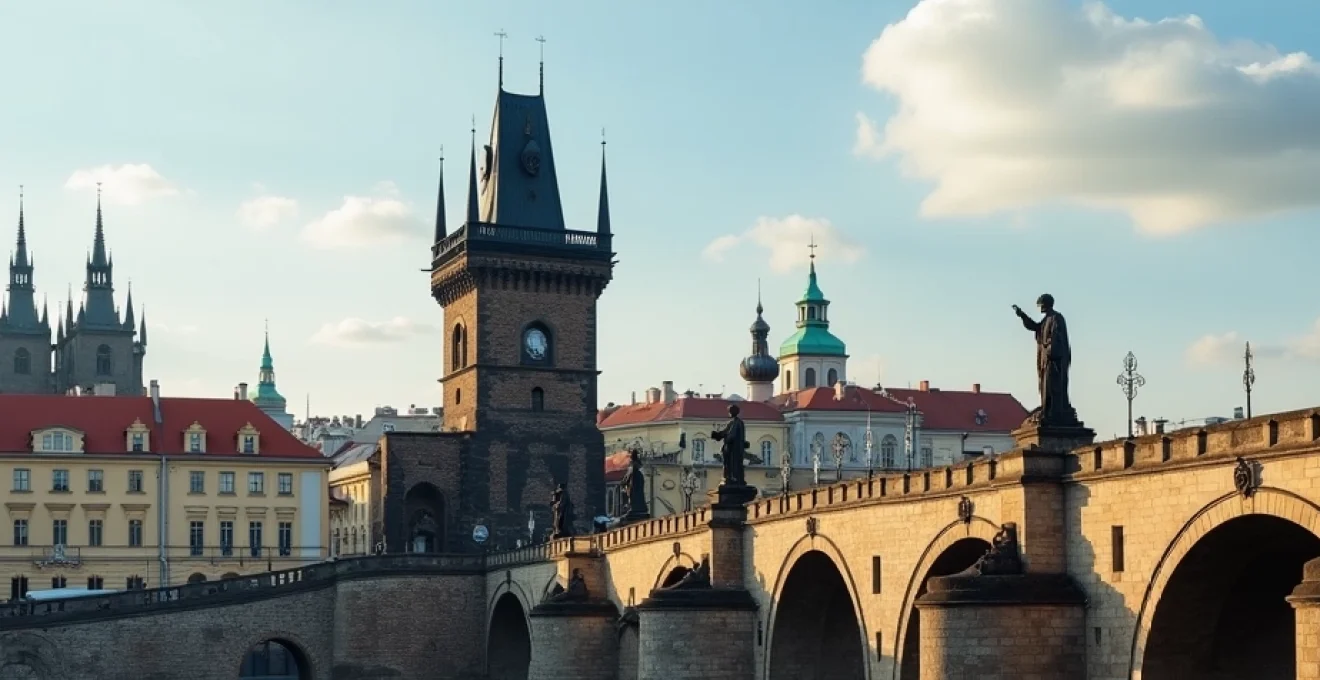
Prague’s Charles Bridge stands as one of Europe’s most magnificent examples of medieval engineering and baroque artistry, drawing millions of visitors annually to witness its timeless beauty. This iconic 14th-century stone bridge spans the Vltava River, connecting the historic Old Town with the enchanting Lesser Town beneath the shadow of Prague Castle. Beyond its role as a mere crossing, Charles Bridge represents a living museum where Gothic architecture meets baroque sculpture, creating an unparalleled cultural experience that has captivated travellers for over six centuries.
The bridge’s enduring appeal lies not only in its architectural grandeur but also in its remarkable collection of 30 baroque statues that transform the structure into an open-air gallery. From the early morning mist that shrouds its sandstone pillars to the golden hour light that illuminates its gothic towers, Charles Bridge offers photographers and visitors alike an ever-changing canvas of medieval splendour. Whether you’re drawn by its historical significance, artistic treasures, or simply the breathtaking views it affords, this masterpiece of Bohemian craftsmanship demands careful planning to fully appreciate its many layers of beauty and meaning.
Historical architecture and gothic engineering of charles bridge
The architectural legacy of Charles Bridge represents one of the most ambitious engineering projects of medieval Europe, commissioned by Holy Roman Emperor Charles IV in 1357 to replace the flood-damaged Judith Bridge. The foundation stone was laid on 9 July 1357 at precisely 5:31 AM, a time chosen by royal astronomers to create the palindromic sequence 1-3-5-7-9-7-5-3-1, believed to imbue the structure with mystical protection. This attention to numerological detail reflects the medieval understanding that successful construction required both practical engineering and spiritual favour.
Peter parler’s 14th century construction techniques and stone masonry
Master builder Peter Parler, already renowned for his work on St. Vitus Cathedral, employed revolutionary construction techniques that pushed the boundaries of 14th-century engineering. His workshop developed innovative methods for quarrying, transporting, and placing massive sandstone blocks, some weighing several tonnes. The precision-cut ashlar masonry demonstrates advanced understanding of load distribution, with each stone carefully shaped to interlock with its neighbours, creating a structure capable of withstanding centuries of floods, wars, and weathering.
Parler’s construction methodology included the use of wooden scaffolding systems that could be adjusted to accommodate the bridge’s gentle curve and varying arch spans. The master craftsmen under his direction developed specialised tools for stone cutting, including early versions of the Lewis lifting device for handling heavy blocks. Recent archaeological investigations have revealed that the builders incorporated iron cramps and dowels at critical stress points, demonstrating sophisticated understanding of structural reinforcement techniques that wouldn’t become commonplace until centuries later.
Bohemian sandstone quarrying and material sourcing from beroun
The bridge’s construction relied heavily on high-quality Bohemian sandstone quarried primarily from sites near Beroun, approximately 30 kilometres southwest of Prague. This particular sandstone, known for its durability and workability, contains a unique mineral composition that provides excellent weather resistance whilst remaining relatively soft during initial carving. The quarrying operation required sophisticated logistics, with stone blocks transported via river barges down the Berounka and Vltava rivers to the construction site.
Analysis of the bridge’s masonry reveals that builders selected different grades of sandstone for specific purposes: harder, more weather-resistant varieties for exposed surfaces and softer stones for detailed carving work. The quarrying process involved techniques such as controlled splitting using wooden wedges, which expanded when wetted, and the use of iron tools for precise shaping. Archaeological evidence suggests that master stone carvers worked at the quarry sites, pre-shaping blocks to reduce transportation weight and ensure precise fit upon arrival at the bridge.
Medieval bridge foundation engineering in vltava river bedrock
The foundation work for Charles Bridge required innovative solutions to the challenges posed by the Vltava River’s variable flow and soft riverbed sediments. Engineers employed a combination of techniques including coffer damming, pile driving, and the strategic placement of massive stone blocks to create stable foundations reaching down to the bedrock. The 16 piers supporting the bridge were constructed using a method called caisson sinking, where watertight chambers allowed workers to excavate underwater whilst maintaining dry working conditions.
Each pier foundation extends approximately 4-6 metres below the riverbed, with the deepest foundations reaching bedrock through layers of alluvial deposits. The builders used a sophisticated understanding of hydraulics, angling the upstream faces of piers to minimise water turbulence and prevent scour erosion. Recent underwater surveys have revealed that the original builders incorporated breakwater structures upstream of each pier, further protecting the foundations from flood damage whilst maintaining navigable channels for river traffic.
Structural analysis of 16 gothic arches and load distribution systems
The bridge’s 16 arches demonstrate masterful application of gothic engineering principles, with spans varying from 16.62 to 23.38 metres depending on the specific hydraulic and geological conditions at each location. Each arch employs pointed gothic profile that efficiently transfers loads through compression forces to the supporting piers, minimising the need for additional buttressing. The varying arch spans create a graceful rhythm along the bridge’s 515.76-metre length, whilst optimising structural performance for local conditions.
Load distribution analysis reveals that the builders incorporated subtle design variations to accommodate differential settlement and thermal expansion. The arch rings consist of precisely cut voussoirs (wedge-shaped stones) that lock together under compression, creating structures capable of bearing enormous loads whilst maintaining flexibility during seismic events or flood-induced vibrations. Modern engineering studies have confirmed that the original design provides significant safety margins, explaining the bridge’s survival through numerous natural disasters and human conflicts over more than six centuries.
Baroque statuary collection and sculptural heritage conservation
The transformation of Charles Bridge into a baroque sculpture gallery began in 1683 with the installation of the first statue of St. John of Nepomuk, marking the beginning of a sculptural programme that would continue for nearly two and a half centuries. This collection of 30 statues and sculptural groups represents one of Europe’s most significant outdoor baroque galleries, featuring works by some of the greatest sculptors of the Habsburg period. The statuary programme served both decorative and propagandistic purposes, reinforcing Catholic Counter-Reformation ideology whilst creating an unparalleled artistic experience for bridge users.
Saint john of nepomuk monument and Counter-Reformation symbolism
The bronze statue of St. John of Nepomuk, created by Jan Brokoff in 1683, holds particular significance as both the oldest sculpture on the bridge and a powerful symbol of Counter-Reformation Catholicism. The statue commemorates the priest who was allegedly tortured and thrown from the bridge in 1393 for refusing to reveal the secrets of the confessional, making him a martyr for religious privacy and clerical independence. The iconic five-star halo surrounding the saint’s head has become one of the most recognisable symbols of Prague, representing the five letters of the Latin word “tacet” (silent).
The monument’s placement and iconography were carefully calculated to promote Catholic devotion during a period of religious uncertainty in Bohemia. The bronze relief panels on the statue’s base depict key moments from the saint’s life and martyrdom, serving as visual sermons for the largely illiterate population. The tradition of touching the relief for good luck has resulted in distinctive polishing of the bronze surface, creating a powerful connection between contemporary visitors and centuries of previous pilgrims and travellers.
Matthias braun and ferdinand brokoff masterpieces authentication
The sculptures of Matthias Braun and Ferdinand Brokoff represent the pinnacle of baroque artistry on Charles Bridge, with their dynamic compositions and emotional intensity setting new standards for religious sculpture. Braun’s masterpiece, “The Vision of St. Lutgard” (1710), demonstrates his ability to capture mystical religious experience in stone, depicting the saint’s vision of Christ embracing her at the cross. The sculpture’s flowing drapery and passionate gesture reveal Braun’s deep understanding of baroque dramatic principles and his exceptional skill in manipulating sandstone to achieve almost textile-like effects.
Ferdinand Brokoff’s contributions include several major sculptural groups, most notably the statues of St. Francis Xavier and St. Vincent Ferrer with St. Prokop. His work demonstrates sophisticated understanding of visual narrative, with complex multi-figure compositions that tell complete stories through gesture, expression, and symbolic attributes. Authentication of these masterpieces relies on detailed stylistic analysis, historical documentation, and increasingly, scientific techniques such as stone provenance analysis and microscopic examination of carving tool marks.
Weathering patterns on limestone sculptures and restoration protocols
The baroque statues face constant environmental challenges from Prague’s continental climate, urban pollution, and the corrosive effects of centuries of weathering. Sandstone’s porous nature makes it particularly susceptible to freeze-thaw cycles, salt crystallisation, and biological colonisation by lichens and algae. Detailed monitoring of weathering patterns has revealed that sculptures facing southwest experience the most severe deterioration due to prevailing wind-driven rain and thermal cycling from solar exposure.
Contemporary restoration protocols developed by Czech conservation specialists employ a combination of traditional and modern techniques to preserve the sculptures’ artistic and historical integrity. Laser cleaning technology allows for precise removal of surface deposits without damaging the underlying stone, whilst specially formulated consolidants strengthen weakened sandstone matrices. Many original sculptures have been relocated to climate-controlled museum environments, with carefully crafted replicas taking their places on the bridge to ensure both preservation and continued public access to these artistic treasures.
Religious iconography interpretation and catholic saints identification
Understanding the religious iconography of Charles Bridge’s statuary requires knowledge of Catholic hagiography, baroque artistic conventions, and the specific historical context of Counter-Reformation Bohemia. Each statue includes carefully chosen attributes and symbols that identify the depicted saint and communicate aspects of their spiritual significance. For example, St. Barbara typically appears with a tower (referencing her imprisonment by her pagan father), whilst St. Christopher carries the Christ child across a river, symbolising his role as patron of travellers.
The sculptural programme follows a sophisticated theological hierarchy, with the most important saints positioned at key locations along the bridge. The placement of missionary saints like St. Francis Xavier near the centre of the bridge emphasises the Catholic Church’s global evangelisation efforts, whilst local Bohemian saints reinforce regional religious identity. Visitors can enhance their experience by learning to recognise common iconographic elements such as martyrs’ palms , bishops’ mitres, and monastic habits, which provide visual clues to each figure’s identity and significance within the broader narrative of Catholic devotion.
Optimal photography conditions and technical camera settings
Photographing Charles Bridge successfully requires understanding the complex interplay of natural lighting, architectural features, and crowd dynamics that define this iconic location. The bridge’s east-west orientation creates distinct lighting conditions throughout the day, with the most dramatic opportunities occurring during the golden hours when warm light illuminates the sandstone surfaces and creates striking contrasts with the darker waters of the Vltava River. Professional photographers and enthusiastic amateurs alike must consider seasonal variations, weather patterns, and the practical challenges of working in one of Prague’s busiest tourist destinations.
Golden hour lighting analysis for mala strana tower captures
The optimal golden hour photography window typically occurs 30-45 minutes before sunset when the warm, angled light creates dramatic side-lighting across the bridge’s baroque statues and gothic towers. During this period, the Lesser Town Bridge Towers become particularly photogenic as the western light illuminates their façades whilst casting long shadows that emphasise architectural details. Photographers should position themselves on the eastern approach to capture this lighting effect, using the towers as foreground elements whilst incorporating Prague Castle in the background composition.
Seasonal variations significantly affect golden hour timing and quality, with summer months providing extended shooting windows but potentially hazier atmospheric conditions. Winter photography offers clearer air and more dramatic cloud formations, though shorter daylight hours require precise timing. Smartphone photography apps such as PhotoPills or Sun Surveyor can help photographers plan optimal shooting positions and predict exact lighting conditions for specific dates and times throughout the year.
Wide-angle lens distortion correction for bridge panoramas
Capturing the full span of Charles Bridge requires careful lens selection and post-processing techniques to manage the geometric distortion inherent in wide-angle photography. Ultra-wide lenses (14-24mm on full-frame sensors) provide the necessary field of view but introduce significant barrel distortion that can make the bridge appear unnaturally curved. Professional photographers often employ perspective correction techniques during post-processing, using software such as Adobe Lightroom’s lens correction tools or specialised applications like DxO ViewPoint to restore natural proportions.
For panoramic compositions that showcase the bridge’s full 515-metre length, photographers can employ stitching techniques using multiple overlapping images captured with moderate wide-angle lenses (24-35mm). This approach provides superior image quality and natural perspective whilst avoiding the extreme distortion of ultra-wide single exposures. When planning panoramic shots, maintaining consistent exposure settings across all frames ensures seamless blending, particularly important given the varying light conditions that can occur along the bridge’s length during golden hour photography.
Long exposure techniques for vltava river motion blur effects
Creating dramatic motion blur effects in the Vltava River requires mastery of long exposure techniques, typically employing exposure times between 1-30 seconds depending on desired aesthetic effects and water flow conditions. Neutral density filters become essential tools for achieving these extended exposures during daylight hours, with 6-10 stop ND filters allowing for sufficient exposure extension even in bright conditions. The resulting smooth, glass-like water surface creates elegant contrast with the sharp architectural details of the bridge and surrounding buildings.
Successful long exposure photography demands absolute camera stability, making sturdy tripods and remote release systems essential equipment. Wind conditions significantly affect stability, particularly when using longer focal length lenses or during extended exposure times. Mirror lock-up functions or electronic first curtain shutter modes help minimise camera shake, whilst some photographers employ additional techniques such as weighted tripods or lens collar support for telephoto compositions that include distant Prague Castle elements.
Crowd management strategies for unobstructed composition angles
Managing crowds for photography on Charles Bridge requires strategic timing, positioning, and patience, as the bridge attracts over 30,000 daily visitors during peak season. Early morning photography sessions, beginning before 6:00 AM, provide the most reliable opportunities for relatively crowd-free compositions, though some tourists and street performers may still be present. Alternative strategies include visiting during inclement weather when tourist numbers drop significantly, or focusing on detail shots and creative angles that work around rather than avoiding human presence.
Compositional techniques can turn crowds into photographic assets rather than obstacles, using longer shutter speeds to create motion blur that suggests the bridge’s vibrant atmosphere whilst maintaining focus on architectural elements. High vantage points from either bridge tower offer elevated perspectives that naturally separate architectural subjects from pedestrian activity below. Professional photographers often employ telephoto compression techniques from distant positions along the riverbank, creating dramatic compositions that emphasise the bridge’s monumental scale whilst minimising crowd visibility in the final image.
Lesser town tower access and astronomical clock viewpoints
The Lesser Town Bridge Towers provide some of Prague’s most spectacular elevated viewpoints, offering unique perspectives of Charles Bridge, the Vltava River, and the historic city centre that cannot be achieved from ground level. These twin towers, constructed during different historical periods, represent architectural evolution from Romanesque through Gothic to Renaissance styles, creating a fascinating study in medieval building techniques whilst serving as premier observation platforms. Access to the towers requires advance planning, particularly during peak tourist seasons when visitor numbers are limited to preserve the structural integrity of these ancient monuments.
The climbing experience involves navigating narrow spiral staircases that wind through the towers’ interior spaces, passing chambers that once served defensive and administrative functions. The older, smaller tower incorporates elements from the original Judith Bridge, providing direct connection to Prague’s earliest stone bridge engineering. From the tower summits, visitors gain appreciation for the sophisticated urban planning of medieval Prague, with clear sight lines extending across the Lesser Town’s baroque palaces, the Petřín Hill’s gardens, and the comprehensive panorama of Old Town’s spires and towers.
Photography from the Lesser Town Towers requires specific equipment considerations, as the elevated position and restricted space limit tripod use and compositional flexibility. Image stabilisation systems become particularly valuable for handheld photography, whilst wide-angle lenses capture the comprehensive urban landscape that extends in all directions. The towers’ medieval window openings frame natural compositions, though photographers must work around the structural elements that can obstruct certain viewing angles. The investment in tower access provides irreplaceable perspectives for serious photographers documenting Prague’s architectural heritage.
The view from Lesser Town Tower transforms one’s understanding of Prague’s medieval urban planning, revealing the sophisticated relationship between defensive structures, river commerce, and residential development that characterised successful Central European cities.
Prague castle pedestrian route planning and navigation systems
Efficient navigation from Charles
Bridge to Prague Castle involves careful route planning through the Lesser Town’s historic streets, where medieval urban layout creates both scenic opportunities and potential navigation challenges. The most direct pedestrian route follows Mostecká Street from the bridge’s western terminus, leading through a series of baroque squares and narrow passages that showcase some of Prague’s finest architectural heritage. This approximately 800-metre journey typically requires 15-20 minutes of unhurried walking, though the abundance of photogenic locations and historical sites along the way often extends visit duration significantly.
Modern navigation systems including Google Maps and specialized Prague tourism apps provide accurate routing, though the historic street layout can sometimes confuse GPS signals in areas with tall buildings or narrow passages. Offline map applications prove particularly valuable for international visitors concerned about data usage, whilst printed maps remain reliable backup options for areas where digital signals may be inconsistent. The route’s gentle uphill gradient becomes more pronounced as walkers approach the castle complex, making comfortable footwear essential for extended exploration.
Alternative routing options include the scenic path through Kampa Island, which adds approximately 10 minutes but provides spectacular riverside views and opportunities to visit the Kampa Museum’s contemporary art collections. Advanced route planning should consider seasonal factors such as winter ice conditions on cobblestone surfaces, summer crowd congestion during peak hours, and the operational schedules of attractions along the way. Professional tour guides often recommend specific timing strategies to optimize both castle access and return journey lighting conditions for photography.
Street performer regulations and cultural experience guidelines
Charles Bridge’s vibrant street performer scene operates under specific municipal regulations designed to balance cultural enrichment with heritage site preservation and visitor safety. Licensed performers must obtain permits from Prague’s municipal authorities, with designated performance zones marked along the bridge to ensure pedestrian flow and emergency access remain unobstructed. The permit system includes requirements for appropriate amplification levels, performance duration limits, and specific restrictions on activities that might damage the historic stone surfaces or baroque statuary.
The diverse range of permitted performances includes classical musicians, traditional Czech folk artists, portrait painters, caricature artists, and skilled craftspeople demonstrating historical techniques such as glass blowing or metalworking. Performance quality varies considerably, with some artists achieving near-professional standards whilst others provide more casual entertainment. Visitors should approach performer interactions with reasonable expectations, understanding that tips represent the primary income source for these cultural contributors who enhance the bridge’s authentic medieval marketplace atmosphere.
Photography of street performers requires consideration of both legal and ethical guidelines, as professional performers often depend on portrait sales for income. Respectful engagement protocols include asking permission before photographing performers closely, particularly those creating visual art or engaged in detailed craftwork. Many performers welcome interaction and can provide fascinating insights into traditional Czech cultural practices, local history, and artistic techniques that have been passed down through generations of Prague’s creative community.
Regulatory enforcement ensures that performance activities maintain appropriate standards whilst preserving the bridge’s primary function as a pedestrian thoroughfare and tourist destination. Municipal inspectors regularly monitor compliance with noise ordinances, safety requirements, and licensing conditions. Visitors experiencing issues with aggressive solicitation or inappropriate behaviour can report concerns to uniformed police officers who patrol the bridge regularly, particularly during peak tourist hours and evening periods when alcohol-related incidents occasionally occur.
The street performer tradition on Charles Bridge represents a living continuation of medieval marketplace culture, where artisans and entertainers have gathered for centuries to share their skills with travellers crossing between Prague’s historic districts.
Seasonal variations significantly affect performer presence and diversity, with summer months featuring the largest variety of artists and most extensive performance schedules. Winter conditions limit outdoor activities to hardy musicians and artists equipped for cold weather performance, though the atmospheric quality of music echoing off snow-covered stone creates particularly memorable experiences. Cultural sensitivity guidelines encourage visitors to appreciate performances as authentic expressions of Czech artistic heritage rather than mere tourist entertainment, fostering respectful cultural exchange between international visitors and local creative communities.
Economic considerations surrounding street performance include understanding that purchasing artwork, requesting custom portraits, or providing generous tips directly supports Prague’s independent artist community. Quality handcrafted items available from bridge vendors often represent superior value compared to mass-produced souvenirs available in commercial tourist shops. Negotiation practices vary among different performer types, with visual artists typically more flexible on pricing than musicians whose services follow more standardized fee structures for special requests or extended performances.